Srbija
 Hrvatska
 Slovenija

Dodik continues Moscow tour, gains support from Shoigu


Former Republika Srpska president Milorad Dodik continued his visit to Moscow on Wednesday, holding separate meetings with Sergei Shoigu, Secretary of Russia’s Security Council, and Yury Ushakov, adviser to Russian President Vladimir Putin.
Seeking to shore up his political position after losing the presidency of the Republika Srpska (RS) entity in BiH when sentenced to one year in prison, Dodik had previously sought backing in Belgrade and Budapest, arriving in Moscow on Tuesday with the same aim.
He was first received by Russian Foreign Minister Sergei Lavrov, who publicly pledged continued support, a message Shoigu reiterated on Wednesday.
At the start of the meeting, which was open to television cameras, Shoigu said the agenda included developments in both Bosnia and Herzegovina and Serbia.
"Of course, the situation is quite tense, but we hope that the measures taken by Republika Srpska, supported by Russia, will bear fruit," said Shoigu, a former Russian defence minister who held the post when the aggression against Ukraine began.
Dodik, for his part, said he was confident the situation was “under control”, while complaining of pressure from the West.

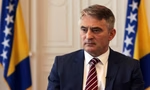
"The Westerners are still trying to eliminate anyone who doesn’t suit them, especially Germany and Britain. They want to finish their unfinished business in the Balkans and sanction anyone they don’t like," Dodik declared.
On Tuesday, alongside Lavrov, he had already railed against London and Berlin, calling them the greatest enemies of Republika Srpska and himself personally, while repeating old claims that he now hoped for greater understanding from Washington, specifically from figures in Donald Trump’s circle.
Those expectations have so far produced no results. In Moscow on Tuesday, Dodik claimed this was due to the continued influence of the "deep state", meaning officials who had worked for Democratic administrations.
In his view, such figures remain responsible for Bosnia and Herzegovina policy, which is why attempts by Banja Luka politicians, with the help of Republican-aligned lobbyists, to have sanctions lifted have failed.
Bosnian media reported this week that there had been a rotation at the top of the US Embassy, though only at the chargé d'affaires level, as no new ambassador has been appointed since Michael Murphy’s mandate expired in February.
The position of chargé d'affaires has now been taken up by John Ginkel, a career diplomat who arrived in Sarajevo directly from Kyiv, where he had served in the same deputy role.
He is reportedly expected to remain in Bosnia and Herzegovina for at least a year. The media have dubbed him a "crisis ambassador", noting his previous service in the US mission in Afghanistan and his role at the State Department’s Bureau of Counterterrorism.
He has also previously served in the diplomatic corps in Kosovo, as well as earlier postings in Sarajevo.
Kakvo je tvoje mišljenje o ovome?
Učestvuj u diskusiji ili pročitaj komentare


Kakvo je tvoje mišljenje o ovome?
Učestvuj u diskusiji ili pročitaj komentare